


Why Builders, Not Talkers, Will Define the Next Era of Work, AI, and Opportunity
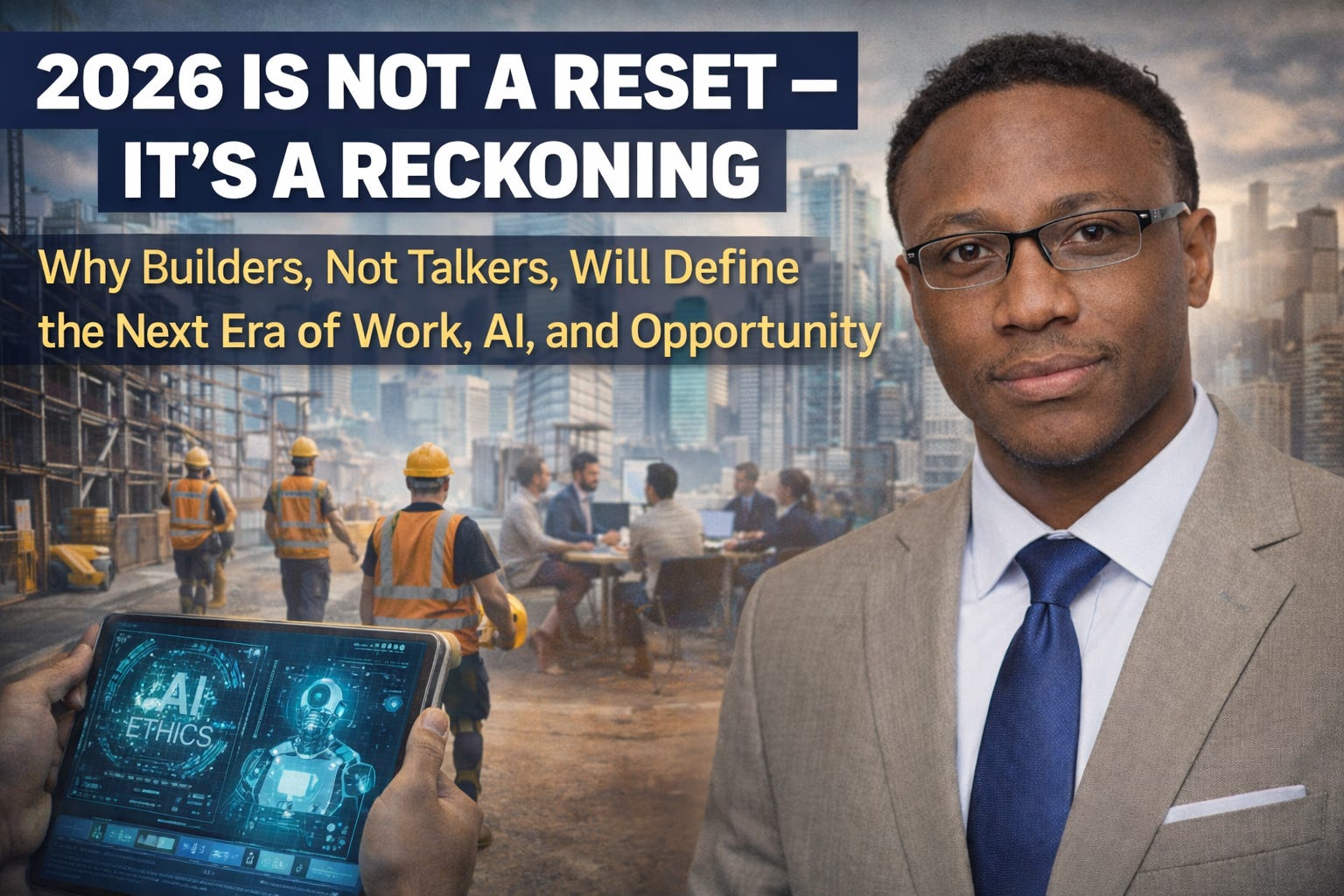
The world did not magically reset at midnight on January 1st, 2026.
What changed was clarity.
2025 exposed the cracks we were trying to ignore broken hiring systems, inflated credentials, shallow AI hype, fragile startups, and economies running faster than people can adapt. Degrees alone no longer guarantee work. Skills without proof no longer convince employers. And technology without purpose is beginning to feel empty.
2026 is not about starting over.
It is about reckoning with what actually works.
The Experience Gap Is Now the Central Crisis
We spent the last decade talking about skills.
The real problem was experience.
Millions of capable people know how to learn, but cannot prove they can work. Employers say “entry-level” while demanding three years of experience. AI accelerates productivity, yet widens inequality for those locked out of opportunity.
This is no longer an education problem.
It is career infrastructure failure.
In 2026, the most valuable platforms will not be content libraries or certificates. They will be systems that convert learning into verifiable work evidence real tasks, real outputs, real signals employers trust.
That is the shift defining this decade.
AI’s Real Test Begins Now
2024 and 2025 were about AI excitement.
2026 is about AI accountability.
The question is no longer “Can AI do this?”
The question is “Should AI do this and for whom?”
AI will either:
deepen exclusion by rewarding only the already-privileged, or
expand access by lowering barriers to experience, mentorship, and opportunity.
The difference lies in design.
Ethical AI is not about policy documents alone. It is about what problems we choose to solve. Systems that help people practice real work, simulate decisions, receive feedback, and grow competence will matter far more than flashy demos.
In 2026, AI that creates opportunity will outlast AI that only creates noise.
Founders Must Grow Up
This year will be unforgiving to surface-level entrepreneurship.
Decks without substance.
Vision without execution.
Buzzwords without governance.
They will not survive.
The founders who endure in 2026 will be builders, people who understand systems, users, regulation, and long-term trust. Not everything needs to scale instantly. Some things need to work properly first.
We are entering a season where:
credibility matters more than virality
structure matters more than speed
resilience matters more than hype
This is good news.
It means the ecosystem is maturing.
Why I’m Building Anyway
I am entering 2026 convinced of one thing:
The future of work will belong to those who can prove what they can do, not just claim what they know.
This belief has shaped everything I build from career simulations to micro-internships, from verifiable skill signals to platforms designed to bridge education and employment realistically.
Not because it’s easy.
But because it’s necessary.
I’ve seen what happens when talent is wasted not due to lack of intelligence, but lack of access. I’ve lived the long nights of building without applause, learning without guarantees, and trusting that integrity compounds even when timelines stretch.
2026 is not about shortcuts.
It is about alignment.
A Personal Commitment for 2026
This year, I commit to:
building systems that respect people’s dignity
designing technology that widens access, not narrows it
choosing depth over noise
and measuring success by real impact, not optics
If 2025 taught us anything, it’s that pretending is expensive.
2026 belongs to those willing to do the work.